
Amazon Integration / Business Central
Amazon FBA vs FBM: What's the Difference?
D365 Zone Services · Sep 21, 2026
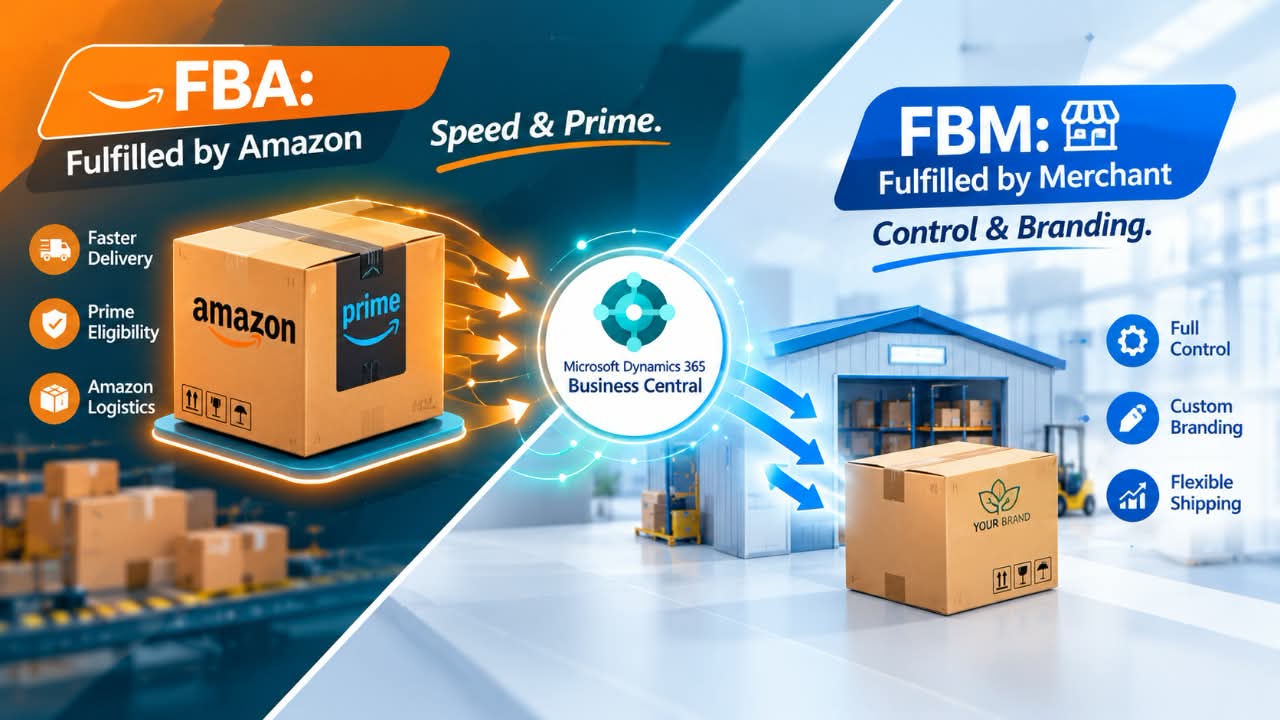
Choosing between FBA and FBM is one of the most important decisions any Amazon seller has to make. The choice between FBA (Fulfilled by Amazon) and FBM (Fulfilled by Merchant) affects inventory storage, delivery costs, customer service responsibilities, and profitability.
FBA and FBM are Amazon's two primary fulfillment programs. The main difference is the level of control over the fulfillment process and the responsibilities associated with it. Here are the key points Amazon sellers should consider when choosing between FBA and FBM.
What Is Amazon FBA?
FBA is a program in which Amazon fulfills orders by picking and packing items, shipping them to customers, receiving payments, and processing returns.
- Storage: Products are shipped to Amazon's warehouses.
- Picking and packing: Done by Amazon employees.
- Shipping: Amazon delivers products to customers.
- Returns and customer service: Managed by Amazon.
What Is Amazon FBM?
With FBM, the seller fulfills orders directly. The Amazon seller handles all aspects of the order, including shipping, packing, returns, and payments.
- Inventory: Stored in the seller's warehouse.
- Fulfillment: Done in-house or through a third-party logistics (3PL) company.
- Shipping: Managed through the seller's choice of carrier.
- Tracking: The seller provides tracking information in Amazon's system.
- Control: Sellers have complete control over the fulfillment process.
Comparison of FBA and FBM
| Factor | FBA | FBM |
|---|---|---|
| Inventory location | Amazon warehouse | Seller warehouse or 3PL |
| Fulfillment labor | Amazon | Seller |
| Prime eligibility | Yes | Only with Seller Fulfilled Prime |
| Shipping control | Limited | More control |
| Customer service | Managed by Amazon | Seller-managed |
Amazon FBA and FBM: Business Central Integration
Regardless of the fulfillment option chosen, Amazon sellers need an integration between their ERP (Enterprise Resource Planning) system and Amazon Seller Central to streamline operations and grow profitably.
Business Central integration with Amazon Seller Central provides a complete view of seller performance and automates repetitive tasks.
For Amazon FBA, Business Central integration enables synchronized orders, warehouse inventory and settlement information, automated fee tracking, and refund reconciliation.
For FBM, the integration enables automated creation of sales orders in Business Central, real-time synchronization of warehouse inventory, shipment and tracking information sent back to Amazon, and stock levels matched across all sales channels.
Regardless of the fulfillment model chosen, Amazon inventory management becomes streamlined with transparent, business-centric integration.
What's the Best Model for My Business?
To determine whether FBA or FBM is more profitable, Amazon sellers should analyze:
- Number of units sold: Consider whether sales volume is high or low.
- Profit margin: Compare FBA fees with FBM costs.
- Level of control: FBM provides a higher level of control.
- SKU-specific nuances: Some products are more cost-effective to ship through one model.
The majority of Amazon sellers use a hybrid approach. Some orders are fulfilled through Amazon while others are fulfilled by the merchant, which is especially common for multi-channel sellers.
How to Connect FBA and FBM in Business Central
The ability to work at scale with Amazon Seller Central requires advanced integration with Microsoft Dynamics 365 Business Central. Connect Amazon to Business Central and eliminate the need to manually enter data into Excel spreadsheets.
D365 Zone Services
Microsoft Dynamics 365 Business Central implementation, integration, migration and support.
- UAE Office: Office 1406, Vision Tower, Business Bay, Dubai
- USA Office: InCorp Services, Inc., 55 W 14th St, Ste 101, Helena, MT 59601
- Email: sales@d365zone.com
- Phone: +1 (707) 731-6403
Areas served: United States, United Kingdom, France, United Arab Emirates, Saudi Arabia, Australia, Netherlands, Canada, Ireland, Germany, Belgium, Switzerland, Luxembourg, Sweden, Norway, Denmark, Qatar, Kuwait, Bahrain, New Zealand, Singapore
Keep Reading
- Amazon Integration for Business Central — Sync Amazon orders, inventory, fees, and fulfillment with Business Central.
- Amazon FBA Integration with Business Central — Why FBA orders, fees, and refunds belong in your ERP.
- Amazon's External Fulfillment Shipping API — Manage self-fulfilled Amazon orders and shipment updates from your ERP.
- Managing Bundles and Kits in Business Central — Keep bundle stock accurate with Assembly Management across sales channels.
- Business Central Integration Services — Connect Business Central to your stores, marketplaces, banks, and tools.