
Business Central / Payroll
Business Central Payroll in the UAE and Saudi Arabia
Dynamics 365 Zone · Oct 26, 2026
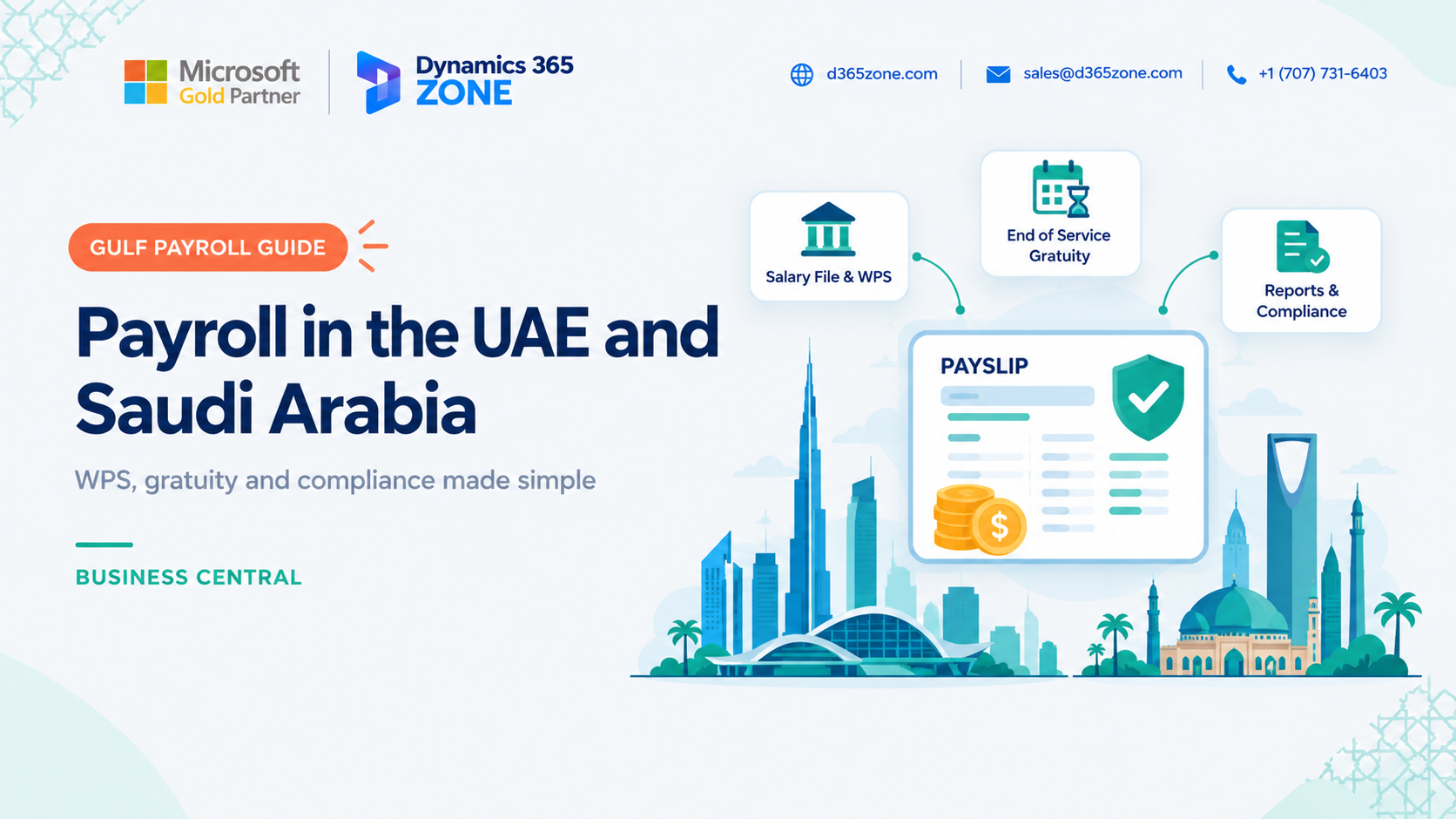
Payroll in the UAE and Saudi Arabia involves more than calculating salaries. Employers also need to consider approved salary payment and reporting processes, end-of-service benefits, social insurance, leave and allowances, and the records required by local authorities.
Microsoft Dynamics 365 Business Central is a strong finance and operations platform, but its standard functionality does not by itself cover every Gulf payroll calculation or compliance requirement. The right approach is usually a country-appropriate payroll solution or extension connected to Business Central for financial posting and reporting. For a broader overview, read what Business Central can and cannot do for payroll.
This article is a practical overview, not legal or payroll advice. Requirements and rates change, and the correct treatment depends on the employee, contract, and circumstances. Confirm current obligations with the relevant authorities and a qualified local payroll adviser.
Why Gulf Payroll Needs More Than the Standard ERP
A payroll run may include basic salary, housing or transport allowances, deductions, overtime, and employer contributions. These elements can have different rules depending on the country and the purpose of a calculation. End-of-service benefits, for example, are not necessarily based on every component of an employee's total compensation.
Employers also need processes for local salary reporting, employee classifications, and documents that may need to be issued in Arabic or bilingually. As legislation and implementation requirements can change, avoid hard-coding rates or formulas without an accountable update and review process.
Wage Protection and Salary File Processes
Both countries have regulated electronic salary payment and reporting processes. In the UAE, employers subject to the Wage Protection System (WPS) generally process wages through approved channels and submit the required salary information in the applicable format. Delays or rejected files can lead to compliance and operational issues, so payroll approval, file validation, payment, and reconciliation should be treated as one controlled process.
In Saudi Arabia, private-sector wage protection reporting is associated with the Mudad platform. Employers need a reliable process to prepare and submit salary information in the required format and address rejected or mismatched records.
A payroll solution connected to Business Central may help produce the necessary output from an approved pay run, but do not assume a generic ERP journal is itself a compliant salary file. Confirm the current file format, submission process, deadlines, and coverage for your company with the relevant authority or provider.
End-of-Service Benefits and Gratuity
End-of-service benefits are an important part of workforce cost planning in both the UAE and Saudi Arabia. Rules can depend on service duration, wage basis, contract terms, and how employment ends. Payroll configuration should therefore retain the employee and pay history needed to support the calculation and explain its result.
As a general illustration, UAE gratuity for eligible employees is commonly described using 21 days of basic wage per year for the first five years of service and 30 days per year thereafter, subject to a cap and the applicable legal conditions. In Saudi Arabia, the commonly described end-of-service award is half a month's wage per year for the first five years and one month's wage for each later year, with resignation-related entitlements and other cases subject to specific rules.
These summaries are not a substitute for checking the current law. Verify eligibility, the wage base, partial-year treatment, caps, contract type, and termination or resignation scenarios before configuring a calculation. Many employers also record a periodic end-of-service provision in the general ledger, with a reconciliation process that compares the provision to updated employee-level estimates.
Saudi Arabia: GOSI and Workforce Requirements
Employers in Saudi Arabia need to account for General Organization for Social Insurance (GOSI) obligations. Applicable contribution rules can vary by employee category and other factors, and rates or transition rules may change. Keep employee classifications accurate, use a maintained payroll configuration, and confirm current requirements directly with GOSI or an authorized local adviser rather than relying on a static rate in an article.
Saudi national employment ratios and related workforce requirements may also affect business compliance. Accurate employee nationality and employment records can support workforce reporting, but payroll data should be handled according to the relevant reporting requirements and privacy controls.
Leave, Overtime, and Allowances
Leave entitlements, overtime, working hours, and allowances need to be set up according to the relevant country's current rules and the employee's terms. Areas to validate in your payroll process include:
- Leave: Annual, sick, and parental leave entitlements, balances, payment treatment, and any applicable settlement for unused leave.
- Overtime: Eligibility, calculation basis, and applicable rates for overtime, night work, or work on rest days.
- Working hours: Applicable working-hour rules, including any seasonal adjustments such as those during Ramadan.
- Pay elements: Clear separation of basic wage and allowances such as housing or transport, especially where a benefit calculation uses a defined wage basis.
Have local payroll specialists confirm these rules before a payroll system is configured. Test representative employee scenarios, including changes in salary, leave, and employment status.
Arabic Documents and Employee Communication
Depending on the business and local requirements, employees or authorities may need payslips, contracts, or reports in Arabic or bilingual formats. Validate the language, terminology, date and number formats, and right-to-left layout in the payroll output itself; translating a template without testing can leave figures difficult to read or key information misaligned.
Business Central can be used in Arabic with the appropriate language configuration. See our guide to the Arabic language experience in Business Central, and confirm that the payroll extension or provider supports the specific Arabic documents your process requires.
Posting Payroll to Business Central
After payroll is approved, post the financial results to the appropriate general ledger accounts. Depending on the pay run, entries may include salary and allowance expenses, employer contributions, end-of-service provisions, and amounts payable to employees or authorities.
Use dimensions such as department, project, or location consistently if managers need to analyze staff costs by team or branch. Agree the level of journal detail with Finance, reconcile totals to payroll reports and bank payments, and retain an audit trail for adjustments. If payroll is posted only as one total, you will have less detail for budget comparisons and management reporting. Our guide to HR analytics and payroll cost reporting explains how consistent financial data can support those reports.
What to Check When Selecting a Payroll Setup
Before selecting a local payroll add-on, external provider, or custom solution, confirm that it can:
- Support the applicable rules for the UAE, Saudi Arabia, and each employee group in scope.
- Prepare and validate the required salary payment and reporting files.
- Handle end-of-service calculations and preserve the history needed to review them.
- Maintain leave, overtime, allowances, and social insurance rules as requirements change.
- Produce the required Arabic or bilingual employee documents.
- Post reconciled payroll entries to Business Central accounts and dimensions, with an appropriate audit trail.
Ask who maintains legal updates, how changes are tested, what support is provided, and how exceptions are handled. A payroll demonstration should include realistic employee scenarios, not just a standard monthly salary run.
Conclusion
Business Central can provide the financial foundation for payroll in the UAE and Saudi Arabia, but local requirements such as salary reporting, end-of-service benefits, GOSI, leave rules, and Arabic documents need an appropriately configured and maintained payroll process.
Plan how payroll calculations are validated, how required files are submitted, and how approved results are reconciled and posted to the ledger. Verify legal details with current official guidance and qualified local specialists.
Need help with Gulf payroll in Business Central?
Speak with our team about connecting a suitable HR and payroll setup to your Business Central environment.
D365 Zone Services
Microsoft Dynamics 365 Business Central implementation, integration, migration and support.
- UAE Office: Office 1406, Vision Tower, Business Bay, Dubai
- USA Office: InCorp Services, Inc., 55 W 14th St, Ste 101, Helena, MT 59601
- Email: sales@d365zone.com
- Phone: +1 (707) 731-6403
Areas served: United States, United Kingdom, France, United Arab Emirates, Saudi Arabia, Australia, Netherlands, Canada, Ireland, Germany, Belgium, Switzerland, Luxembourg, Sweden, Norway, Denmark, Qatar, Kuwait, Bahrain, New Zealand, Singapore
Keep Reading
- Does Business Central Have Payroll? — What Business Central can do for payroll and how to choose an add-on or integration.
- HR Analytics in Business Central — Use Business Central and Power BI to report on headcount, payroll costs, absence, and turnover.
- HR & Payroll Implementation — Business Central implementation with HR and payroll in one system.
- Business Central Payroll in Australia & South Africa — What payroll setup is needed for local tax compliance, reporting and GL accuracy.
- Arabic Language Pack — Run Business Central in Arabic and switch to English in one click.